
UK AI sovereignty: Can Britain compete without outspending big tech?
Written by

Events Marketing Coordinator at Civo
Written by
Events Marketing Coordinator at Civo
The UK has the talent, ambition, and growing pool of investment to become a major player in artificial intelligence. But with US technology giants dominating the market and growing concerns over access to them, it’s fair to ask whether Britain can build an independent AI future without trying to outspend Big Tech.
When the question was put to the AI panel at Civo Navigate London 2026, the answer was an optimistic yes, but not by default. Britain doesn’t need to match the hyperscalers on spending. It needs the skills to run AI well, infrastructure it controls, and AI systems people can trust.
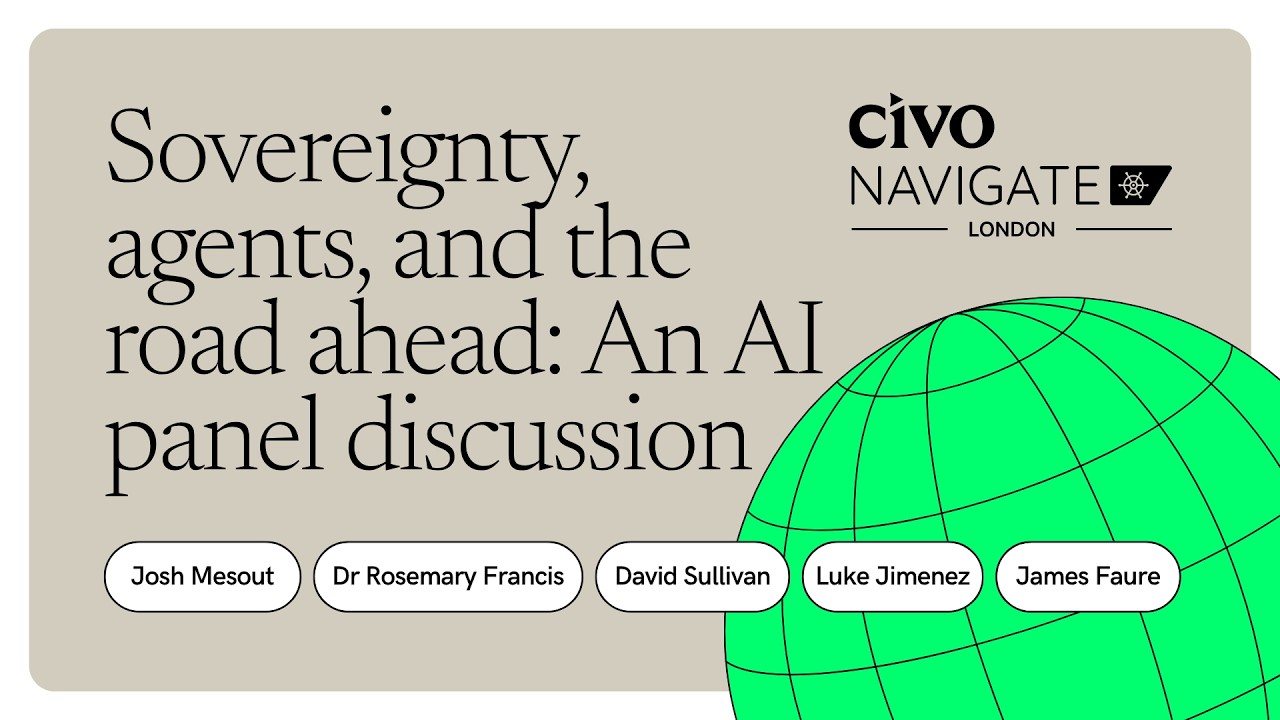
At Civo Navigate London 2026, Josh Mesout, Chief Innovation Officer at Civo, brought together four AI experts to explore that question. The panel featured Luke Jimenez, Founder and CEO of LESSO AI; David Sullivan, Technology Director at Starling Bank; James Faure, Director of Agentic AI at R3NQUIST; and Rosemary Francis, CTO at CommonAI Compute.
5 key takeaways on UK AI sovereignty, security and investment
How are global AI restrictions changing business strategies?
What happens when the AI technology your business depends on suddenly becomes unavailable? In June 2026, US export controls temporarily disrupted access to certain frontier AI models. Anthropic launched Fable 5 and Mythos 5 on June 9th, 2026. Three days later, US Department of Commerce export controls forced it to suspend access to both models. The controls were lifted on June 30, and access began returning on July 1st.
Josh Mesout opened the discussion by asking how these restrictions were influencing business strategies, particularly for organizations relying on proprietary AI models. For David Sullivan, Technology Director at Starling Bank, the incident brought an existing concern into sharper focus:
“These models getting pulled is something that we knew could happen with the geopolitical risks of the world, but maybe not something that we expected would happen so soon.”
David Sullivan, Technology Director, Starling Bank
Speaking from the perspective of a heavily regulated industry, David also referenced the FCA Mills Review, highlighting the need for financial institutions to treat AI providers as material operational risks and manage their dependencies accordingly.
James Faure raised another challenge: the hesitation some organizations have towards using Chinese-developed AI models, even when they can be hosted independently.
“People don’t also understand sometimes that if you’re self-hosting something, that it’s not in China. The data is not going to China. It’s still in your own little bubble…”
James Faure, Director of Agentic AI, R3NQUIST
As businesses reconsider their reliance on closed-source models, James argued that open source alternatives deserve greater consideration. While these models introduce their own challenges, organizations can mitigate risks by developing internal expertise or working with trusted hosting providers.
For Luke Jimenez, the issue was particularly relevant to education. His company, LESSO AI, had chosen sovereign infrastructure from the outset to protect sensitive school and teacher data. The disruption reinforced the importance of maintaining control over technology that handles sensitive information.
Together, their perspectives reveal a broader shift in how businesses approach AI infrastructure. Choosing the most capable model is no longer enough. Organizations also need to understand who controls access, how easily they can switch providers, and what happens when a critical service becomes unavailable.
Mark Boost (Civo, CEO) explores this further in The AI kill switch problem nobody wants to talk about, examining why portability, resilience, and control are becoming essential considerations as businesses grow increasingly dependent on AI.
For organizations building AI into their operations, sovereignty is no longer just about where data lives. It's about maintaining the freedom to choose, adapt and retain control over the technology they rely on.
Can open-weight AI models deliver genuine sovereignty?
Open-weight AI models are becoming increasingly competitive with proprietary alternatives, offering businesses greater flexibility over how their technology is deployed. According to Mozilla's State of Open Source AI report, 79% of surveyed developers use open models, but only 51% of teams using them have deployed them in production.
So, does access to model weights automatically give organizations control?
David Sullivan, Technology Director at Starling Bank, explained why the transition from experimentation to production isn't always straightforward:
"If you were to have true open source weight models, you have to have the full life cycle and the deployment of it... You need to invest in the skills and knowledge to be able to do those things."
David Sullivan, Technology Director, Starling Bank
The challenge isn't simply accessing a model. Organizations must also manage security, governance, fine-tuning, and the resources required to support it.
James Faure also highlighted the potential of model distillation, where larger models help train smaller, specialized models for specific tasks. This can reduce costs and improve efficiency without relying on the most expensive model for every application. This echoes an earlier observation from Dr Rosemary Francis, when she identified,
“It’s ridiculous to use the most expensive model for every task. It’s ridiculous from a balance sheet point of view. As I said, it’s only going to get more expensive. It’s not the way we should be using the planet’s resources as well. And don’t forget how quickly these models are moving. If the latest frontier model, proprietary model, is slightly better than an open source model, who cares? Everything else matters so much that that difference is really negligible.”
Dr. Rosemary Francis, CTO, CommonAI Compute
Open-weight models offer organizations a route towards greater independence, but access alone doesn't guarantee sovereignty. The real challenge lies in developing the skills, infrastructure and expertise to deploy, adapt and manage these models effectively.
Who is responsible when AI agents go wrong?
As AI agents take on more complex tasks, organizations face a difficult question: who is accountable when something goes wrong?
Josh asked whether responsibility lies with the model provider or the business deploying the application. For David Sullivan, the answer was clear:
"I think the safety around AI is a serious issue. I think on the accountability piece, the FCA and banking have been very clear. You can’t outsource accountability to AI. And obviously, as an FCA-regulated bank, we tend to agree with them. You can’t outsource the accountability of these things going wrong to OpenAI, to Anthropic, to Google."
David Sullivan, Technology Director, Starling Bank
Rosemary Francis pushed the conversation further, arguing that simply instructing an agent not to perform certain actions isn't enough. Effective safeguards require secure sandboxes, enforceable limits on what agents can access, and controls that restrict the damage if something fails.
“I think the takeaway is that we do need to develop genuine sandboxes, genuine guardrails that are easy to deploy. We shouldn’t be leaving decisions about how to securely use agents in a development or production environment … down to the decisions of the individual engineers.”
Dr. Rosemary Francis, CTO, CommonAI Compute
It's the difference between asking an AI system to behave responsibly and engineering an environment that limits what it can actually do.
While sovereign infrastructure gives organizations greater control over where their AI systems operate, it doesn't remove their responsibility for what those systems do. As AI agents become more autonomous, accountability, testing and enforceable safeguards must remain central to how they're developed and deployed.
Where should the UK invest to become a global AI leader?
In June 2026, the UK government announced a £1.1 billion AI Hardware Plan, including investment in computing capacity, semiconductor development and British technology companies.
With funding accelerating, Josh asked the panel where investment should go first: compute, models, applications or skills?
For Dr Rosemary Francis, investing in people was non-negotiable. She challenged a familiar concern among employers about investing in employees who might eventually leave by saying, "What happens if we don't train them and they stay?"
Her point extends beyond employee retention. Developing technical expertise strengthens the UK's ability to build, deploy and manage AI systems, while helping businesses remain competitive as technology evolves. Rosemary also emphasized that talent alone isn't enough. Greater collaboration between government, businesses and research organizations will be essential to competing internationally.
"We've got the pieces in this country to be able to compete with some of the largest organizations in the world, but we're only going to do that by working together."
Rosemary Francis, CTO, Common AI Compute
Luke Jimenez, Founder and CEO of LESSO AI, brought the discussion back to education and the importance of preparing the next generation of technical talent.
"We’ve got the talent here, but what about in 5 years, 10 years, 20 years? I think that education as a whole probably needs a bit of a shake-up, and we need to think about what it’s going to look like in that time rather than trying to plug gaps now. And then beyond that, the compute. So I think along the lines of the meritocracy scenario, where you give everyone the equal opportunity to go out and do what they want to do, give people the compute, give them the skills that they need, and let them be able to build whatever technology we need moving forward.”
Luke Jimenez, Founder and CEO, LESSO AI
Luke challenged whether the UK's education system is evolving quickly enough to meet the demands of emerging technologies. Rather than focusing solely on today's skills shortages, he argued for rethinking how people learn, develop, and access the tools needed to innovate.
With Luke Jimenez’s perspective on education, questioning whether the UK is preparing people for the skills they'll need in five, ten, or twenty years. His argument for giving more people access to computing resources and the knowledge to build with emerging technologies, together, their perspectives raised an important point; funding powerful hardware is only part of the equation. Britain also needs people who can use it effectively.
Investing in AI infrastructure is essential, but the UK's long-term success will depend just as much on the people developing and using it. From training today's technical workforce to preparing the next generation, building the right skills will be critical to turning investment into meaningful innovation.
Does the UK need to compete with US AI giants to succeed?
Perhaps the most interesting question raised by the panel was whether Britain should attempt to compete directly with the world's largest AI companies at all.
“I think we’re not going to outspend the US hyperscalers, nor do I think we should, especially with some of the stats we’ve talked about around the closing gap with open weights models. … There’s a huge scientific community and a lot of knowledge and expertise around not only how to build these models, but how to use them effectively.
David Sullivan, Technology Director, Starling Bank
Instead, David Sullivan suggested the UK could build on its scientific expertise, AI safety capabilities and ability to develop specialized solutions for different industries.
Rosemary Francis reinforced this argument when discussing the global AI supply chain:
"No country has got every piece of the AI stack. We will never have that. But no other country will ever have that. Every country needs to rely on other countries for their AI technology, whether that’s models or whether it’s rare earth metals for building the hardware. And so we need to look as a country where we can be a critical piece in that AI infrastructure stack. We have a lot of resources. We have a lot of clever people, and we are very well placed to be a critical piece in that infrastructure."
Rosemary Francis, CTO, Common AI Compute
From chips and energy to frontier models, the AI supply chain is global by design. The opportunity for the UK may lie in becoming an essential contributor to that ecosystem rather than trying to replicate it.
David also raised another important challenge: public trust.
"I think it’s all well and good thinking that the bottleneck is how do we get as many chips in the country and as many electrons and build the best models possible, but if people don’t trust them and aren’t willing to use them, then why are we doing it? So I actually think for the UK, and again it maybe leans into some of the specialties, the UK is very much positioning itself as a kind of AI safety leader, and I think that’s really where we can make a difference."
David Sullivan, Technology Director, Starling Bank
With the UK positioning itself as a leader in AI safety, developing technology that people trust could prove just as valuable as investing in more computing power.
Britain doesn't need to build everything or match Big Tech's spending to become a global AI leader. By focusing on specialized technology, trusted AI systems and the areas where it already has expertise, the UK can strengthen its position as an essential contributor to the global AI ecosystem.
The UK's AI future is about capability, not just capital
So, can the UK build a sovereign AI future without outspending Big Tech? The panel's answer was an optimistic yes, but not by default.
As David Sullivan argued, Britain doesn't need to outspend the hyperscalers. Instead, its strength lies in developing the capabilities that matter: the technical talent to build and deploy AI, the infrastructure to support it, and the safeguards that make it trustworthy. From Rosemary Francis's call for greater investment in people to Luke Jimenez's vision for the next generation of technical talent, one thing became clear: the UK's competitive advantage will depend as much on the people behind the technology as the technology itself.
As AI becomes increasingly embedded in everyday life, building systems that people can trust is just as important as making them more powerful.
Sovereignty isn't about doing everything alone. It's about having the independence to make meaningful choices.
At Civo, we believe greater choice, transparency, and control are essential to building an AI ecosystem that works for businesses, developers, and the communities they serve.
UK sovereign cloud, built your way
Civo’s UK sovereign cloud delivers a full suite of public cloud, private cloud, and AI services, all hosted and operated exclusively within the United Kingdom.
Designed for organizations that require absolute clarity over jurisdiction, it ensures your data, infrastructure, and governance remain firmly under UK legal authority, with no exposure to foreign control.

Events Marketing Coordinator at Civo
Debora Tonet is the Events Marketing Coordinator at Civo, responsible for planning and executing events that bring the Civo community together, from meetups and conferences to partner activations and industry gatherings.
She brings over a decade of experience spanning creative direction, cultural strategy, branding, and digital storytelling. She is the founder of Black Girls in Fashion, a platform created to connect and amplify Black women in the fashion industry, through which she has led community strategy and content development with a focus on inclusion and impact. Her work has taken her into collaboration with organisations including the British Fashion Council and London Fashion Week.
Share this article