
Can you ban an idea? What we learned about open source at Civo Navigate London 2026
Written by

Events Marketing Coordinator at Civo
Written by
Events Marketing Coordinator at Civo
More and more, we are hearing how artificial intelligence is transforming how we build, secure, and share software. But as AI models become more powerful, questions around openness, security, and digital sovereignty are becoming harder to ignore.
Can open models really be controlled? Is AI putting open-source communities under pressure? What does genuine technological independence look like? And who decides who gets access?
At Civo Navigate London 2026, Amanda Brock, CEO of OpenUK, brought together Kelsey Hightower, Dinesh Majrekar (CTO at Civo), Liz Rice (Chief Open Source Officer at Isovalent), and Matt Barker (co-founder and CEO of BoltMCP) to explore the opportunities, challenges, and future of open source in an AI-driven world.
From geopolitical tensions to the growing pressure on open source maintainers, here are five key takeaways from the discussion.
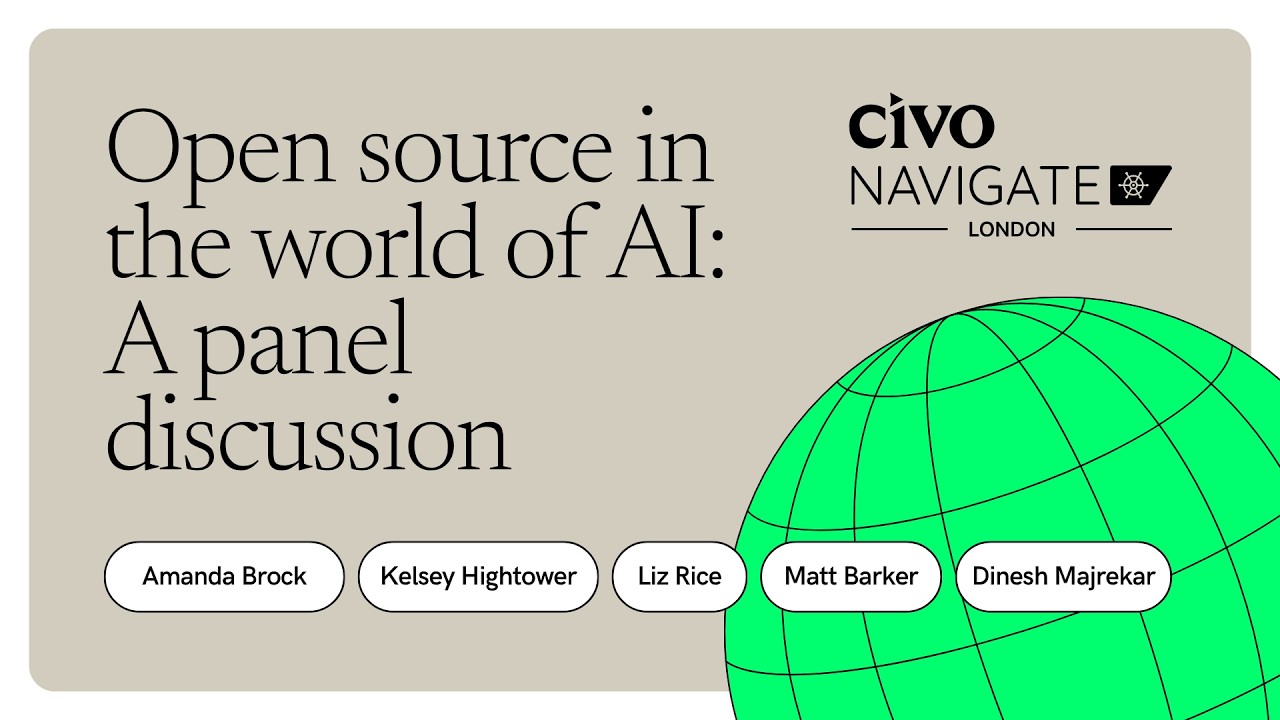
5 key takeaways on open source, AI and the future of innovation
Can open models really be banned?
As governments consider tighter controls on AI development and distribution, the panel questioned whether restricting access to open models would achieve its intended purpose.
Kelsey Hightower challenged the idea that governments could effectively contain AI innovation, particularly as competitive models continue to emerge internationally.
“So I don’t even think we’re an open model. I think people are really worried about competition. So I think the future of this is will there be competition? Yes. Is it coming from China right now, and they’re doing a good job? Yes. If people want to build pseudo-monopolies or duopolies, can they do that when the models are cheap? It becomes really, really hard.”
Kelsey Hightower
He also highlighted an important distinction between open-weight models, which provide access to model parameters, and genuinely open models that offer greater transparency into training data and processes. Liz Rice shared a notable takeaway:
"I think the cat is already out of the bag in that if one particular government decided to, you know, completely close borders. There are still other alternative models out there from different countries... It's a good thing that there isn't only one option concentrated in one part of the world."
Liz Rice, Chief Open Source Officer at Isovalent
Restricting access in one country doesn't necessarily stop innovation elsewhere. With AI development taking place across international borders, the debate is increasingly about competition, control, and who gets to participate.
Can AI models ever be truly secure?
AI's potential to accelerate innovation comes with a difficult security challenge... how do you protect systems whose behavior cannot always be predicted?
Kelsey questioned whether traditional software testing could adequately assess large language models, given their complexity and range of possible outputs:
"Systems tend to behave differently when under test than they behave in the real world. We don't know what to do with this. Anyone that claims that they can test it, I don't think they're being truthful."
Kelsey Hightower
Liz expanded on the challenge, explaining how AI is accelerating vulnerability discovery while traditional patching processes struggle to keep pace.
"Last year’s Mandiant M-Trends Report found that the mean time to exploit was actually negative. It was a negative seven days. So exploits are in the wild being exploited a week before anybody even… officially knows that they exist.
Patching is great. We have to fix those bugs. But in the window between an exploit starting and somebody being able to roll out a patch, we need runtime mitigations and guardrails."
Liz Rice, Chief Open Source Officer at Isovalent
Her argument centered on runtime security, which focuses on controlling what software is permitted to do while it is operating, rather than relying solely on fixing vulnerabilities after they have been identified.
For organizations adopting AI, the message was clear throughout this panel discussion…security needs to extend beyond pre-release testing and become part of how systems are managed in real time.
Why do open standards matter for AI agents?
As businesses explore AI agents capable of interacting with enterprise systems, questions around connectivity, permissions and control are becoming increasingly important.
Matt highlighted the risks of relying on a single AI provider, particularly when organizations need flexibility across different models and applications.
"But more than that I think enterprises realized that well it was only a few years ago there were a number of people arguing to me that there was going to be only one model to do everything. And at the time it was going to be an OpenAI model. I think now, fast-forward a few years we realize there’s going to be a long tale of models and they’re going to be fine-tuned. They’re going to be smaller. They’re going to be open source. Some are going to be proprietary. And I think enterprises are the ones that realize that they need to own some optionality on the models that they use for the particular task in hand."
Matt Barker, CEO and Co-Founder at BoltMCP
Rather than locking organizations into one ecosystem, open standards offer a foundation for flexibility, innovation and greater control over how AI interacts with business-critical systems.
What does true AI sovereignty look like?
Every AI stack is built from global parts. So what does “sovereign” actually mean?
Amanda put the paradox plainly. She has “always found the sovereign conversation a bit confusing because you have to use globally collaborative tools underneath it.” Dinesh didn’t pretend otherwise. At the bottom of the stack, there’s little choice to make, “there’s basically one inference provider in the world at the moment, and that’s Nvidia.” This shows us that sovereignty can’t mean building every component at home. Dinesh echoed a point Civo CEO Mark Boost made earlier that day… it comes down to “who can turn that off and who can start denying you access to that.”
“Yes, we can go to something like Anthropic, but if there is a change in policy that says non-US citizens can no longer have access to this model, that’s not your ability to have a sovereign decision.”
Dinesh Majrekar, CTO at Civo
That isn’t a thought experiment. This summer, Anthropic suspended access to two of its newest models for almost three weeks to comply with US export controls. It’s why Dinesh splits sovereignty into “access versus control.”
But control has a price, and Matt named it. The companies he speaks to “would love sovereignty,” but for many of them: “It kind of means potentially not being able to use the most powerful hardware, the most powerful models.”
“Your choices are a higher risk appetite. You’ll see some failures. You will lose some money. You will give it all away to the US, or you have to be slightly behind. There are three choices.”
Dinesh Majrekar, CTO at Civo
In the audience Q&A, Kelsey stripped the debate back to its foundation:
“Sovereignty is a control thing and your ability to defend your control. That’s it. So, if you can’t make a thing, then you don’t have sovereignty. You may have good partnerships. You may have good relationships. And that’s fine until it stops.”
Kelsey Hightower
True sovereignty, therefore, is about meaningful choice and control, even within a globally connected technology ecosystem.
Is AI threatening the future of open source?
AI-generated code is making software development faster, but it is also creating new challenges for the people maintaining open source projects.
Matt highlighted the growing imbalance between the volume of AI-generated contributions and the number of maintainers available to review them.
“I think as much as we can prompt and get thousands, if not millions of lines [of] code back, whether it’s good or bad, we can’t prompt like thousands of new open source maintainers at the same time.
Matt Barker, CEO and Co-Founder at BoltMCP
Liz explained how her project has approached this challenge by prioritizing human understanding and long-term contributor relationships over simply accepting more code.
“Ultimately, we want you as a human to understand what it is that you’re contributing because the fix might be great, but really we’re much more interested in the long term in building up a community of people who really understand the code and understand the values of the project and might ultimately want to take it forward into the future.”
Liz Rice, Chief Open Source Officer at Isovalent
Kelsey offered a different perspective, reminding the audience that open source is fundamentally a mechanism for sharing, not an obligation to build a business or manage an unlimited community.
"I think we have to make sure we understand what open source is. It's not a community. It's not stickers. It's not a business model. It’s none of those things.
I don't think it's possible for open source to fail, mainly because I think humans naturally want to share and fix things."
Kelsey Hightower
The challenge isn't whether people will continue sharing software. It's how open source communities adapt to AI while protecting the people, principles and practices that make collaboration possible.
The future of open source is about choice, control and collaboration
The Open Source and AI panel at Civo Navigate London 2026 highlighted a technology ecosystem at a turning point. As Amanda put it:
“I think there’s a piece here where what we’re actually talking about in this conversation and we’re being forced to talk about because of AI is the value of open source and our values as an open source ecosystem.”
Amanda Brock, CEO of OpenUK
AI is accelerating development and creating new opportunities, but it is also exposing difficult questions about security, sovereignty, commercial sustainability and the future of open source collaboration.
Across the discussion, one theme remained consistent: innovation depends on the ability to choose, adapt, and retain control over the technologies we use.
As AI continues to evolve, open standards, responsible development and sustainable communities will play an important role in ensuring innovation remains accessible rather than concentrated in the hands of a few.
At Civo, we believe that choice, openness, and control are essential to building a more flexible and resilient technology ecosystem.

Events Marketing Coordinator at Civo
Debora Tonet is the Events Marketing Coordinator at Civo, responsible for planning and executing events that bring the Civo community together, from meetups and conferences to partner activations and industry gatherings.
She brings over a decade of experience spanning creative direction, cultural strategy, branding, and digital storytelling. She is the founder of Black Girls in Fashion, a platform created to connect and amplify Black women in the fashion industry, through which she has led community strategy and content development with a focus on inclusion and impact. Her work has taken her into collaboration with organisations including the British Fashion Council and London Fashion Week.
Share this article