
The next wave of AI: Balancing innovation with sovereignty
Written by

Digital Marketing Executive at Civo
Written by
Digital Marketing Executive at Civo
The pace of AI innovation is reshaping research, business, and everyday life. However, as breakthroughs in Large Language Models (LLMs) and high-performance computing accelerate, they bring new technical challenges around scale, efficiency, and reliability.
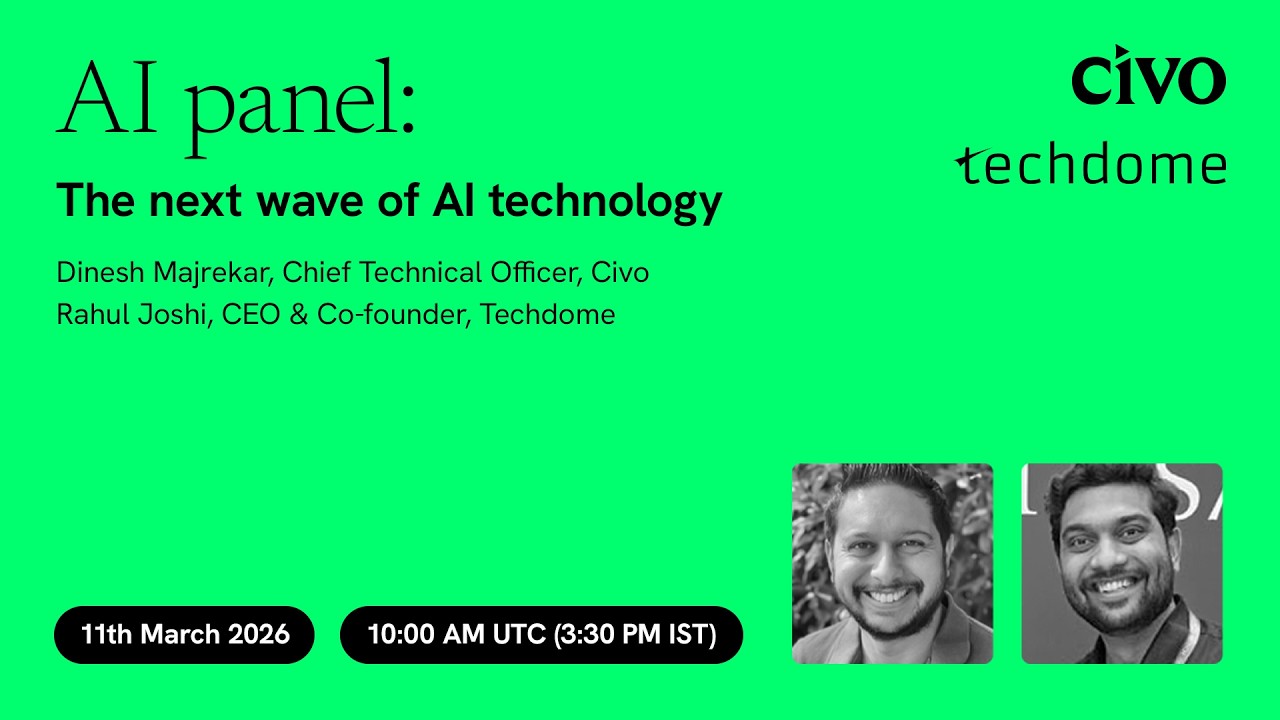
At our recent panel webinar, Simon Hansford (CCO, Civo) sat down with Rahul Joshi (CEO, Techdome) and Dinesh Majrekar (CTO, Civo) to discuss why the next wave of AI is about more than just the smartest model, it’s about who has the most compliant and sovereign infrastructure.
Why is data sovereignty now a business mandate?
The discussion opened with a critical shift in global geopolitics. Data sovereignty is no longer just a compliance checkbox; legislation like the GDPR in Europe and the DPDP Act in India has turned it into a business mandate.
"The next wave of AI isn't just about who has the smartest model, but about who has the most compliant and sovereign infrastructure. We're here today to explore how businesses can balance that need for lightning-fast innovation with the necessity of control."
Simon Hansford, COO of Civo
Historically, sovereignty was seen as a handbrake on innovation, but the reality is the opposite: control is what actually enables speed. By moving to a sovereign stack, businesses stop wasting time auditing "black box" APIs or worrying about cross-border data leakage. You gain total leverage over your data, which is non-negotiable for sectors like healthcare and finance where Techdome is already seeing massive success.
The economics of scale: API vs. self-hosting
One of the most pressing questions for any AI-led business is the "crossover point", the moment when relying on third-party APIs like OpenAI becomes a strategic and financial liability. Rahul Joshi identified a specific benchmark where the transition to private GPUs moves from a luxury to a necessity:
"Normally we keep a benchmark around $5,000... once you're burning that on the API side of it, it's better to fine-tune and deploy a self-host model. Previous to 6 months back, taking GPU servers and deploying your own model was a big hassle. Now, I think it's a click of events."
Rahul Joshi, CEO and Co-Founder of Techdome
Dinesh Majrekar added that self-hosting provides essential business predictability:
"If you are using an OpenAI endpoint, your business finances are intrinsically tied to the cost of token... if tomorrow they decide to put 5 pence on top of every million tokens, your entire business model changes underneath you. Going down a self-hosting option with a provider like Civo... you've locked in the price and can build a business case off the back of that."
Dinesh Majrekar, Civo CTO
Accelerate your performance with Civo GPUs
Enterprise clouds weren’t made for the AI era. So we built one that is. Civo AI puts the power of the latest NVIDIA GPUs and multi-cloud control in your hands without cost, complexity or lock-in. Work at the speed of your ideas, without draining your budget – and keep your data close, compliant and completely under your control.
Real-world AI: Lessons from Techdome
The panel showcased Techdome as a prime example of an "automation-first" organization. Rahul Joshi shared how Techdome has launched over 10 AI-led products in just two years by focusing on execution speed and reducing operational drag using Civo infrastructure.
Key insights from their success include:
- Bridging the platform gap: Moving away from over-engineered cloud solutions to lightweight, production-ready Civo Kubernetes environments that allow models to be deployed in minutes.
- Healthcare innovation: Deploying fine-tuned Llama models to process patient data and answer complex queries directly from medical documentation, drastically reducing the need for large manual support teams.
- HR efficiency: Using real-time AI agents to handle candidate phone screenings and cultural-fit assessments, transforming an eight-hour manual task into a process that takes just minutes.
- Design velocity: Demonstrating how AI can move a project from a client discovery call to a live mockup within the same meeting, allowing teams to focus on excellence over basic layout.
Read the Techdome case study here to learn more.
The 5-Year outlook: From "just Google it" to prompt engineering
As AI becomes the primary interface for information, the panelists discussed a fundamental shift in how the next generation of professionals will work. Rahul Joshi highlighted a growing generational gap, noting that while "Young blood" entering the market today are incredibly proficient with AI agents, the foundational skill of "searching" is being lost, along with the critical thinking that comes with it.
"There was a phrase we always had of, 'just Google it'... and I think we now need to learn how to prompt to get the first response that you need. Once I'm talking to young blood, they don't know the pre-AI era... they have not spent time on learning how to search on Google, make your results better, and understand it. Those are some critical thinkings people should still know."
Rahul Joshi, CEO and Co-Founder of Techdome
The panel agreed that success in an AI-driven market requires using these tools as assistants to further deep understanding, rather than as shortcuts. As Dinesh Majrekar noted, experts will always be needed to validate AI output and ensure it aligns with real-world experience, emphasizing that while technology changes, high-level business remains a human-to-human interaction.
The mandate for a sovereign future
The overarching message was clear: speed is essential, but it cannot come at the expense of jurisdictional control. Organizations looking to lead in the AI era must start with well-defined internal problems, build internal expertise, and choose infrastructure that offers long-term predictability. If you want to learn more about this topic, check out some of these resources:
- How Techdome accelerates AI-led product delivery with Civo Kubernetes
- The economics of a sovereign cloud
- How is the next wave of AI impacting the Indian cloud scene?
- Building smarter with AI: Why legacy infrastructure is the biggest bottleneck
Discover the Civo Sovereign Cloud
Our sovereign cloud offers a comprehensive suite of cloud services, including public, private, and AI solutions, all hosted within the UK or India and designed to ensure the highest levels of data security, compliance, and control.
👉 Find out more about our UK sovereign cloud
👉 Find out more about our India sovereign cloud

Digital Marketing Executive at Civo
Emma Kinsey-Coates is a Digital Marketing Executive at Civo, focused on bringing the brand to life through creative storytelling and multimedia content. She leads the company’s visual strategy across Instagram and YouTube, producing high-impact video and social content that translates complex technical updates into engaging community experiences.
With a background in creative communications and graphic design, Emma manages Civo’s multimedia production, from webinar coordination to social-first video series. She also plays a key role in the company’s PR and awards initiatives, ensuring Civo’s innovations and industry achievements are recognized on a global stage.
Share this article