
Building smarter with AI: Why legacy infrastructure is the biggest bottleneck
Written by

Digital Marketing Executive at Civo
Written by
Digital Marketing Executive at Civo
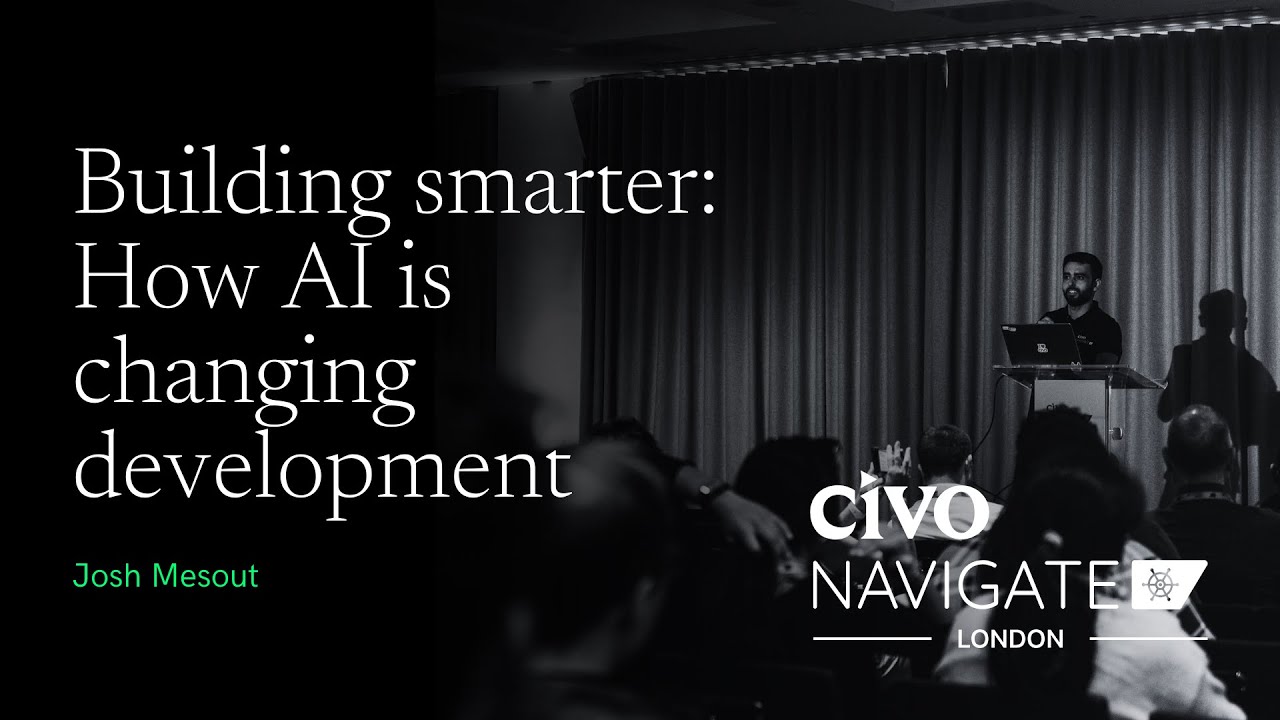
Josh Mesout (Chief Innovation Officer at Civo) took the main stage at Civo Navigate London 2025 to deliver a critical message: The AI revolution isn't just coming, it's here, and the way companies are built is changing faster than ever before.
His session cut through the hype, delivering hard data on what separates the companies that scale AI from the ones that sink money into failed prototypes. The takeaway is blunt: The biggest threat to your AI ambition isn't the model; it’s your infrastructure.
Here’s an unvarnished look at the state of enterprise AI, the hidden costs of legacy cloud, and how Civo is levelling the playing field for the next generation of builders. Catch up with Josh’s session in full 👇
The tipping point: Why this AI wave is different
The shift to Generative AI is not a slow burn; it's a full-on tidal wave. The data is clear, 80% of companies are looking to have Gen AI in production by 2026.
"We're realistically looking at a situation more sudden, more variant than what we saw with mobile transformation."
Josh Mesout, Chief Innovation Officer at Civo
The ease of entry has never been lower. You no longer need a PhD to get started; you can spin up a model, hit an API, and start automating processes that were complex just five years ago.
The irony? For all this unprecedented accessibility, enterprise success remains brutally low. 46% of enterprise AI prototypes fail. Why? The primary killer of AI ambition is not a lack of talent or a poor use case. It's the underlying tech stack.
"Scaling and running AI is hard. It needs multiple expertises, often outside of mathematical, outside of IT, and being able to pull all that together in a single project is often quite challenging.”
This lack of specialist talent, combined with unfit infrastructure, creates a perfect storm. The enthusiasm is there. The business case is compelling. But a decade-old database, a bottlenecked network, or a CPU-first mentality kills the project before it ever gets to production. This is the predictable consequence of trying to run future-proof workloads on legacy hardware.
Data trumps novel architecture
For years, the conversation around AI success was dominated by who had the newest algorithms or the biggest pile of GPUs. Josh flipped this script, emphasizing the true competitive edge: data access.
"It's not just novel architectures. It's not just having all these GPUs in a single location… It's fundamentally about data."
The companies winning today are those who can quickly bridge the gap between their private, valuable, and often siloed data and the public models. Josh argued that access to this data, and the current barriers between private and public datasets, is what is giving companies a massive advantage. Your specific operational history, customer insights, and intellectual property become the ultimate moat.
To underscore the rapid, real-world impact of this technology, Josh highlighted three use cases that are no longer science fiction:
- Drug discovery: 30% of all new drugs and materials are now being systematically generated using AI.
- Marketing automation: 30% of all outbound marketing messages will soon be AI-generated.
- Cultural impact: We will likely see a blockbuster film entirely created by Gen AI by 2026.
These are not theoretical gains. They are direct, measurable transformations that are fundamentally changing the role of human input in high-value industries.
Civo’s answer: A cloud that doesn't need a decade to catch up
When it comes to infrastructure, Civo didn't want to be the same as the incumbents; we wanted to be drastically different. While others patch over legacy systems, Civo built the Gen AI offering for the modern problem.
"If you're using AWS right now, you're probably using a component that's 10 to 15 years old."
Compute with confidence
We believe future workloads demand infrastructure that is flexible, sovereign, and optimized for performance. Civo is built on this foundation:
- GPU-first mentality: All of our compute offerings have GPU acceleration available. Move from CPU to GPU paradigm instantly, not in a complex, multi-step migration.
- Training and inference-ready storage: Civo is one of the only cloud providers that offers training and inference-ready performance across all storage levels (volumes, databases, object store) as a base level. We believe every future workload will demand it.
- Sovereignty, where you need it: Your Gen AI infrastructure shouldn't be constrained by geography or public cloud policies. We offer complete parity between what you can run on-premise (with a machine you can physically touch) and what you can rent in the cloud, allowing you to scale into the cloud when you need to.
The true cost of AI
Josh tackled the common myth that AI is prohibitively expensive. This myth is often propagated by those selling GPUs in batches of 300,000.
"AI is not as expensive if people let it on. We are in some cases seven or eight times cheaper than a hyperscaler."
The rise of efficient, cutting-edge hardware, like the B200 GPU, means that a small business or a focused team can achieve what previously required massive investment. Civo specializes in making this cutting-edge hardware available in the smaller quantities that you actually need, levelling the technological playing field.
How can we make AI accessible to all?
Our white paper, Democratizing AI Infrastructure: Addressing GPU Accessibility and Cost Barriers, uncovers the challenges holding back equitable AI adoption and explores the solutions needed to unlock its full potential.
The agentic future: Managing 50 agents, not five employees
The fundamental shift extends to how we structure work itself. Josh cited McKinsey's mentality: a future where employees are expected to line-manage 50 to 100 AI agents driven by just a handful of human supervisors.
"AI has made more jobs in the last five years than we've seen it take away.”
This isn't about job loss; it's about re-allocating human time to high-value areas like intuition and creativity, and automating the mundane.
A great example of this is IBM's agentic automation of HR transformation saw 94% of all Q&A handled by an agent, a solution that delivered a massive ROI with a single agent. If you have three repetitive support tickets that account for 60% of your effort, you now have a straightforward way to automate that
Summary
Josh’s session at Civo Navigate London was a masterclass in separating the AI hype from the reality of scaling. His key takeaways for builders and decision-makers are clear:
- AI is moving faster than any previous tech shift, but 60% of projects are failing due to unfit infrastructure.
- Your proprietary data is the new competitive advantage, making data access and sovereignty paramount.
- Modern infrastructure isn't optional. Running AI on legacy systems is expensive and often impossible.
Civo is built on the belief that access to modern, high-performance, and sovereign AI infrastructure should be straightforward. We provide the tools, the price point, and the confidence to stop worrying about the cloud and start building the future.
If you want to learn more about this topic, check out some of these resources:

Digital Marketing Executive at Civo
Emma Kinsey-Coates is a Digital Marketing Executive at Civo, focused on bringing the brand to life through creative storytelling and multimedia content. She leads the company’s visual strategy across Instagram and YouTube, producing high-impact video and social content that translates complex technical updates into engaging community experiences.
With a background in creative communications and graphic design, Emma manages Civo’s multimedia production, from webinar coordination to social-first video series. She also plays a key role in the company’s PR and awards initiatives, ensuring Civo’s innovations and industry achievements are recognized on a global stage.
Share this article

