Lock-in is not theoretical: What UK organizations told us about cloud exit barriers
Written by

Chief Executive Officer (CEO) at Civo
Written by
Chief Executive Officer (CEO) at Civo
For years, vendor lock-in has been discussed as a theoretical risk. A concern to acknowledge in architecture reviews. A box to tick in compliance frameworks. A future problem that might need addressing.
Our latest research reveals something more urgent. For UK organizations, lock-in isn't theoretical anymore. It's structural. It's measurable. And it's preventing organizations from acting on their own strategic priorities.
The numbers tell a stark story. 66% of UK IT leaders would consider switching providers to regain control. Yet only 15% have successfully migrated usage to alternative providers. That 51-point gap isn't a planning problem or a knowledge gap. It's evidence of systematic lock-in so entrenched that strategic intention has become operationally irrelevant.
This blog explores what our research reveals about why organizations remain trapped, not by choice, but by accumulated dependencies that have become structural constraints.
The digital sovereignty revolution 2026
Civo has released the Digital Sovereignty Revolution 2026 white paper, exploring how UK businesses are confronting the real cost of cloud dependence.
The exit intention gap where strategy meets reality
The gap between what organizations want to do and what they can actually execute has widened dramatically.
66% would switch to regain control. That's a clear signal. Organizations understand the risks of dependency. They recognize the strategic value of diversification. But when confronted with the practical question, "Can you realistically exit your incumbent provider within 12 months?", the answers become far less optimistic.
Only 1 in 4 leaders truly believes they could exit a major US provider. For a significant minority, the answer is direct. They can't exit at all.
This isn't because organizations lack commitment to sovereignty or diversification. It's because lock-in isn't a single constraint. It's a web of interconnected technical, contractual, and organizational dependencies that accumulate gradually and become progressively harder to unwind.
Lock-in manifests across multiple dimensions simultaneously.
The "free credits" trap
One often-overlooked mechanism that creates organizational lock-in is the strategic use of free credits and promotional offers by hyperscalers.
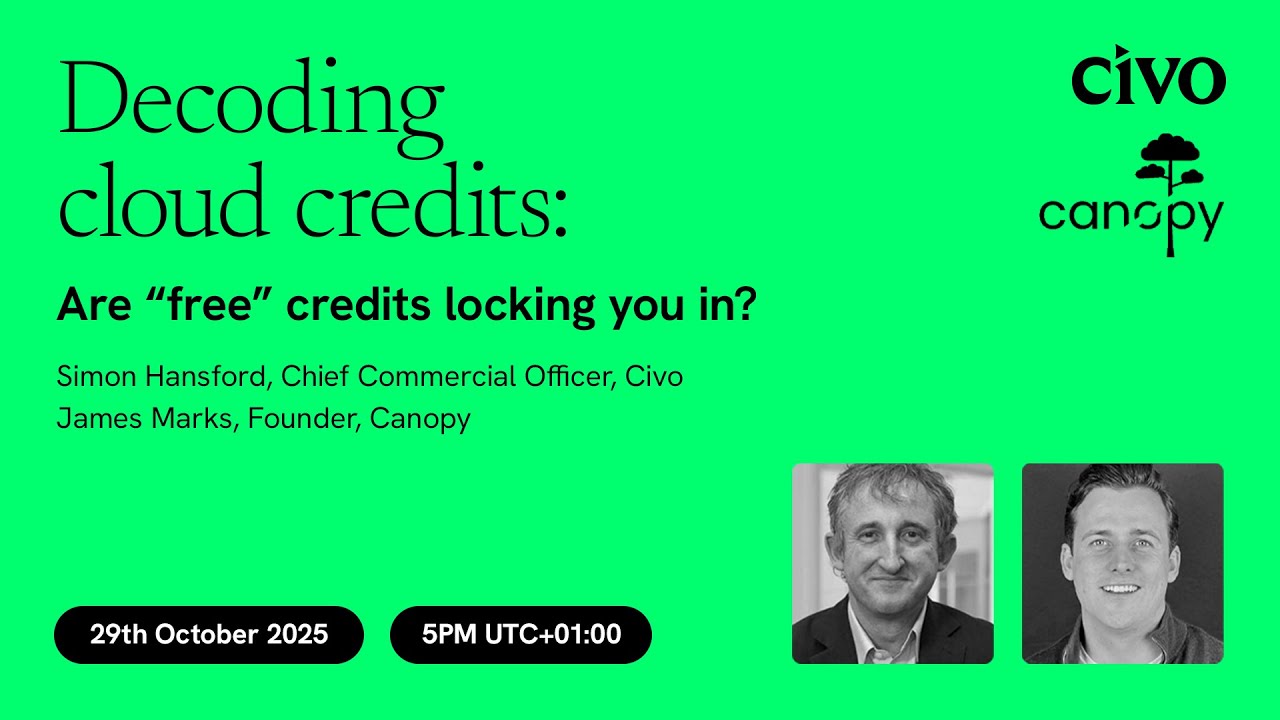
Decoding cloud credits
Uncover the truth about "free" cloud credits. Download our whitepaper to learn how to avoid costly traps and make informed decisions about your cloud infrastructure.
On the surface, free credits appear to accelerate cloud adoption with no financial risk. In practice, they create a subtle lock-in mechanism. Organizations build infrastructure on credits they didn't pay for, become comfortable with a specific provider's tools and processes, and only later discover the true cost when credits expire, and paid consumption begins.
By that point, organizational inertia is powerful. Teams are trained on the provider's platform. Workloads are architected for that provider's capabilities. Changing providers would mean reengineering infrastructure that now feels established and stable.
The credits themselves are rarely transferable, have expiration dates, and typically cannot be applied retroactively to existing consumption. Organizations that don't carefully manage credit-funded consumption often find themselves locked in by the very mechanism meant to reduce risk.
Data opacity: The real lock-in
Beyond technical and contractual constraints, there's a subtler but equally powerful form of lock-in. Lack of visibility into where data actually lives and how it's being governed.
Our research found that only 35% of organizations have full visibility into where their data is stored. For the remaining 65%, data governance has become an administrative blind spot. Data exists somewhere in a provider's global infrastructure, subject to an opaque set of replication policies, failover mechanisms, and compliance configurations that organizations don't fully understand.
This opacity creates lock-in because you can't effectively migrate what you can't see. You can't govern what you don't understand. And you can't make informed decisions about alternative providers when you lack basic visibility into your current infrastructure.
Hyperscalers cite infrastructure complexity as a reason for this opacity. The reality is simpler. Transparent architecture would require providing visibility that contradicts their business model. When visibility is an afterthought rather than a design principle, lock-in becomes the inevitable outcome.
Breaking free: What it actually takes
Breaking free from lock-in requires more than good intentions. Our research with organizations that have successfully navigated migration reveals several critical factors.
The path forward
Lock-in has transformed from a theoretical concern into a documented operational reality. Organizations recognize the problem. They want to diversify. But structural constraints prevent execution.
Breaking this cycle requires action at multiple levels. Organizations must make explicit decisions to prioritize sovereignty and diversify, but they also need viable alternatives operating at competitive scale.
The good news. The market is beginning to respond. Domestic cloud providers are emerging. Costs are becoming more competitive. Open-source solutions are providing pathways to sovereignty without vendor lock-in.
Our full white paper explores these barriers in depth, presenting frameworks for quantifying lock-in costs, strategies for sequenced migration, and case studies of organizations navigating these challenges successfully.

Chief Executive Officer (CEO) at Civo
Mark Boost is the Chief Executive Officer and co-founder of Civo, a cloud computing provider focused on delivering fast, developer-friendly infrastructure. He founded the company in 2018 with the goal of building a modern Kubernetes-powered cloud platform.
Before launching Civo, Mark founded several successful technology companies, including LCN.com, ServerChoice, Ai Networks, and Bulletproof Cyber. With more than two decades of experience building infrastructure and hosting businesses, he has a long track record of scaling technology companies.
Share this article