
The sovereignty of the builder: Lessons from Civo Navigate London 2025
Written by

Digital Marketing Executive at Civo
Written by
Digital Marketing Executive at Civo
Digital sovereignty isn’t won in policy papers. It’s earned in production.
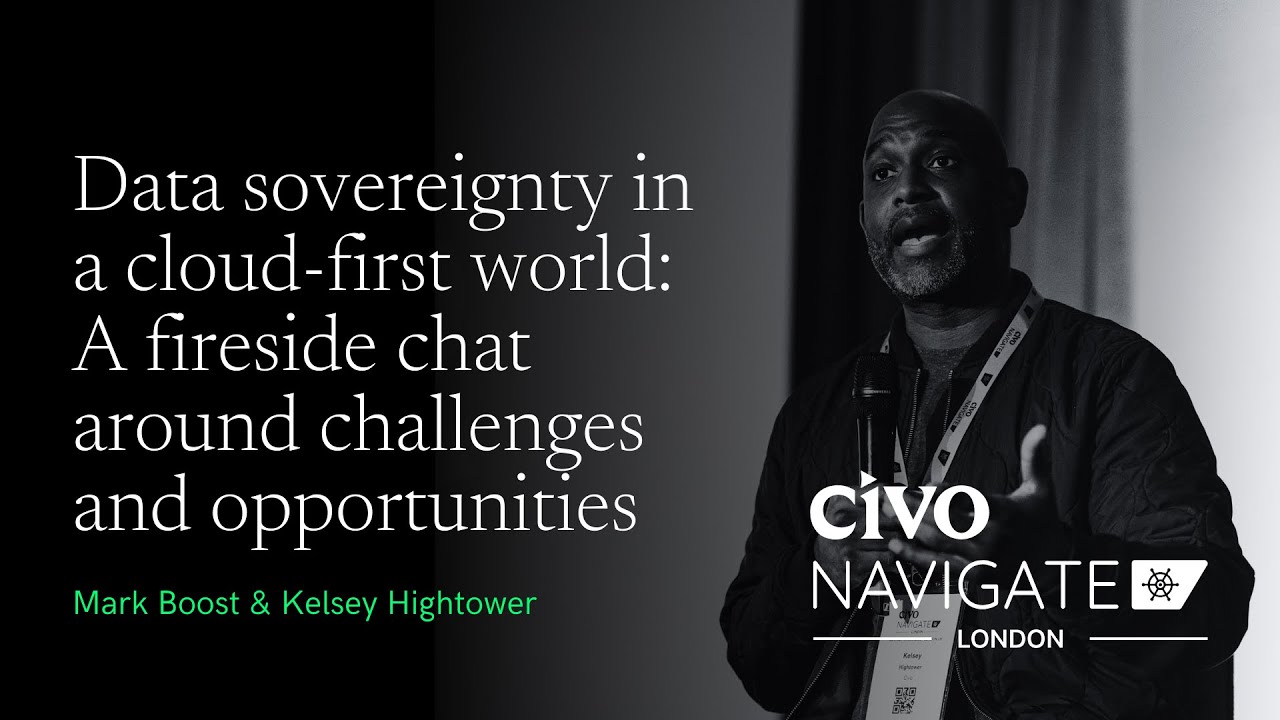
That was the challenge issued by Civo CEO Mark Boost and Board Director Kelsey Hightower at Civo Navigate London 2025. They argued that the cloud's real failure lies not with the providers, but with the customers who refused to change. Catch up on the full fireside chat below 👇
The power shift is underway, moving from large vendors back to the practitioner. The only question is whether builders have the discipline to claim it.
Five key lessons on discipline, openness, and control
The real obstacle to cloud success is internal discipline
Kelsey Hightower argued that the biggest failure of the last decade wasn't the cloud providers; it was the customers. Why did migrations fail? Not because of technology, but because companies simply poured their bad habits into expensive new services.
"The thing I learned in seven years of the cloud was every customer eventually wanted us to make the new thing work the old way... They didn't even move everything. So now you have two things to manage under the same operational model. That was the mistake."
Kelsey Hightower
He stressed that many executives chased "hello revenue" instead of operational discipline, making the fast, flexible cloud service behave exactly like the slow, wasteful systems it was meant to replace. You can't buy discipline; you have to build it.
The AI workload is the ultimate inefficiency trap
Traditional IT lets companies hide waste with big discounts. The AI workload, however, is the ultimate reality check; it’s so compute-intensive that it immediately exposes poor architecture and slack automation. The problem is the hyperscaler pricing model that penalizes you for this inefficiency.
"The thing about the AI workload punishes for bad habits... If you don't have a good architecture, you have no automation, and you're paying a premium to use rented GPUs... I can’t pay this premium for something sitting idle in a cloud provider. It’s too expensive."
Kelsey Hightower
The prohibitive cost of idling specialized hardware (often rented by the day or week from large providers) is now forcing enterprises to ask: Is this worth the premium? The answer is often "no," driving users toward efficient platforms, including Civo, that offer transparent GPU pricing and tools designed to help control spend on high-cost workloads.
Open protocols beat proprietary services every time
If you want stability and true sovereignty, you bet on the standard, not the vendor. Kelsey Hightower explained that the longevity of a technology isn't measured by its creator, but by its adoption as an open protocol.
"Even if the implementation isn't open source, if it uses an open protocol that will do."
This principle is why technologies like Kubernetes, Linux, and Git have succeeded; they became shared standards. When your stack is built on open protocols, you gain the late-mover advantage: you can wait for the technology to mature, achieve security and stability, and then adopt the best, most cost-effective implementation without ever sacrificing choice.
Sovereignty isn't just for nation-states, it's for the coder
The ultimate measure of sovereignty isn't a government tariff; it's the capability of your own team. Kelsey Hightower delivered a sharp point aimed directly at the developers in the room: Control begins with code literacy.
"Sovereignty is the ability to move the needle without permission... If you're in it and you don't know how to code, that means your whole job is in read-only mode. You're just stuck."
If you can't read the code, fix the error, or add a feature, you are reliant on a documentation path provided by someone else. Sovereignty is the ability to see the future you want and make it happen without permission from any external entity.
Data gravity demands compute parity everywhere
The idea that all data must migrate to the public cloud is over. The enormous scale and sensitivity of modern data, especially for AI, mean that compute must follow the data, not the other way around.
Mark Boost set the stage for this new reality, articulating Civo’s core vision:
"In the future there could be regions everywhere. We might not own those regions but it kind of democratizes sovereignty and control into the hands of the users."
Mark Boost, CEO of Civo
Kelsey Hightower reinforced the logic:
"10 years ago, the only way to get access to these tools was to move your stuff to where they were. Now, even the cloud providers want to move the compute to where the data is. Data gravity is still a real thing."
This trend, driven by AI cost, data governance, and sheer latency, necessitates cloud parity: having the same modern, feature-rich cloud experience available in public, private, and local environments, freeing the builder from the geographic limits imposed by large vendors.
Summary
True digital sovereignty isn’t won through regulatory compliance; it’s earned through technical action. This was the clear mandate from the fireside chat at Civo Navigate London 2025.
True digital sovereignty is an operational and ethical mandate. It requires businesses to abandon the inefficiency of the past, embrace the discipline of modern automation, and build on open protocols to avoid lock-in. By providing cloud parity and transparent, efficient pricing for high-cost workloads like AI, Civo is working to ensure that every builder has the freedom to choose their own digital destiny.
If you want to learn more about this topic, check out some of these resources:

Digital Marketing Executive at Civo
Emma Kinsey-Coates is a Digital Marketing Executive at Civo, focused on bringing the brand to life through creative storytelling and multimedia content. She leads the company’s visual strategy across Instagram and YouTube, producing high-impact video and social content that translates complex technical updates into engaging community experiences.
With a background in creative communications and graphic design, Emma manages Civo’s multimedia production, from webinar coordination to social-first video series. She also plays a key role in the company’s PR and awards initiatives, ensuring Civo’s innovations and industry achievements are recognized on a global stage.
Share this article
