
Navigating the geopolitical maze of digital sovereignty at Civo Navigate London 2025
Written by

Digital Marketing Executive at Civo
Written by
Digital Marketing Executive at Civo
Trust in Big Tech is eroding. Geopolitical tensions are rising. The only predictable thing about the cloud today is that it’s time to re-evaluate everything.
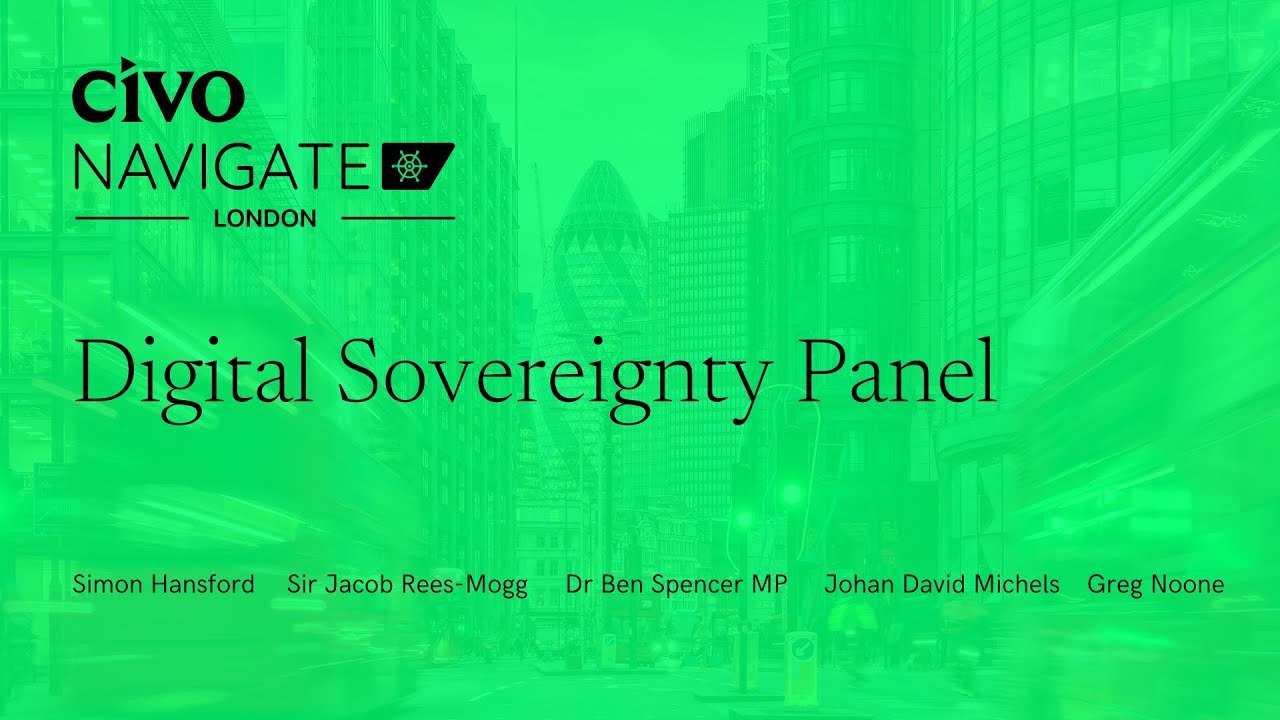
At Civo Navigate London 2025, we pulled together a panel of industry experts to cut through the noise and finally define what digital sovereignty means for the UK.
Moderated by our Chief Commercial Officer, Simon Hansford, the debate featured a unique mix of policymakers and industry leaders: Sir Jacob Rees-Mogg, Dr Ben Spencer MP, Johan David Michels (Cloud Legal Project), and Greg Noone (Tech Monitor).
You can watch the full recording of this panel session here 👇
5 lessons on control, AI, and the UK cloud future
1. Residency is not sovereignty, control is
The conversation started by dismantling a tired old myth. Data residency, choosing a geographic region, is a compliance checkbox, not a solution.
Johan David Michels was clear: genuine sovereignty is about control.
"Having data stored here in the UK isn't going to cut it. Because under US law, the US government can order a cloud provider to hand over your data regardless of where those data are stored."
He clarified you don't have sovereignty if a foreign entity holds a kill switch for your data or service. You just have a local billing address. The real fears are confidentiality and availability.
2. The global ‘Kill Switch’: The US control problem
This isn't hypothetical fear. It's a fact of life for cloud users. The US wields enormous non-military power, and the panel confirmed it isn't afraid to use it.
Sir Jacob Rees-Mogg delivered the core truth of this geopolitical reality:
"The US government wants to get you and sanction you, it doesn’t necessarily need to do it by stopping access to the cloud. It can stop you getting any money in your bank account."
That's the risk. Johan David Michels provided concrete proof: when the US sanctioned the ICC prosecutor Karim Khan, Microsoft "withdrew his access to his work email account." When control is outsourced, security is compromised.
3. The price of compute: The true barrier to UK AI leadership
We see the headlines. £31 billion here. £5 billion there. Politicians love a big number. But Sir Jacob Rees-Mogg called time on the hype. Investment announcements, he reminded us, "all sorts of things that have been announced many times over."
The real obstacle to the UK’s digital future isn't a lack of interest, it’s the balance sheet.
"The real problem is actually our energy prices... Our average industrial electricity price is four times that of the United States... That is the biggest disincentive to high energy usage, AI and other applications coming in to this country."
Building an AI powerhouse requires colossal compute. Colossal compute requires cheap power. Right now, the high cost of energy is a dominant operational blocker to achieving a sovereign, AI-driven future.
4. Procurement: fix the rules, build the cloud
Everyone wants a vibrant ecosystem of UK tech companies. Yet, the single biggest blocker is the government itself. The public sector is sitting on an estimated £14 billion annual spend on digital services, yet smaller, innovative UK companies "just cannot get through government procurement processes," a concern voiced by Dr Ben Spencer MP.
Greg Noone quantified the potential leverage here:
"You can use some of that [procurement power] to help solve this problem of this vibrant British tech ecosystem not... producing the unicorns that it should be doing."
This isn't about protectionism. It's about being authoritative with taxpayer money. It's time to simplify the process and use that massive purchasing power to foster the national champions the UK needs for true resilience.
5. Choice is the prerequisite for true sovereignty
The conversation ended with a crucial takeaway: a sovereign cloud future requires a fair, open market where customers, individuals, small businesses, and government have genuine options.
Dr Ben Spencer MP delivered the final, most defining principle of digital sovereignty:
"It's up to the person, the institution, the organization to make decisions which work best for them, but they need to have choice. We need to have a functioning market for that to operate."
This isn't just about challenging hyperscalers; it's about building a better system. The underlying prerequisite is choice. Without it, you are locked in, and your digital future is controlled elsewhere.
The digital sovereignty revolution
Learn more about how sovereignty is reshaping the UK's tech sector through our research with 1,000+ UK IT decision-makers. From the risks of relying on US-based providers to the benefits of multi-cloud strategies, our whitepaper explores the key trends and implications for businesses.
Summary
The Digital Sovereignty Panel at Civo Navigate London 2025 made it clear: the UK’s strategic goal must be to build resilience and genuine control over its digital future. This means policymakers need to simplify regulation, government must strategically use its procurement power to foster domestic competition, and the industry must find a solution to the high cost of compute. By prioritizing choice and control over simple data residency, the UK can successfully navigate geopolitical tensions and secure its position in the global cloud market.
If you want to learn more about this topic, check out some of these resources:

Digital Marketing Executive at Civo
Emma Kinsey-Coates is a Digital Marketing Executive at Civo, focused on bringing the brand to life through creative storytelling and multimedia content. She leads the company’s visual strategy across Instagram and YouTube, producing high-impact video and social content that translates complex technical updates into engaging community experiences.
With a background in creative communications and graphic design, Emma manages Civo’s multimedia production, from webinar coordination to social-first video series. She also plays a key role in the company’s PR and awards initiatives, ensuring Civo’s innovations and industry achievements are recognized on a global stage.
Share this article
