7 reasons Civo's UK sovereign cloud secures regulated workloads
Written by

Marketing Team at Civo
Written by
Marketing Team at Civo
Sovereignty is one of those words that gets stretched until it means almost nothing. Vendors apply it to any infrastructure with a UK data center, regardless of who owns the parent company or which jurisdiction's courts govern the contract. For a developer running a personal project, that ambiguity is probably fine. For a fintech under FCA oversight, an NHS trust processing patient data, or a legal firm handling privileged communications, it isn't.
The distinction that matters isn't where the server sits within the UK/EU. It's who has legal access to the data on them, under what circumstances, and whether you can prove it to a regulator. That's the standard Civo is built to meet.
1. What is guaranteed data residency?
Data residency gets mentioned in a lot of sales materials. What it means in practice varies considerably. At one end, you have contractual guarantees that data will never leave a defined jurisdiction. At the other end, you have architectural defaults that technically keep data in a given region unless certain conditions trigger a transfer - conditions that may not be visible to you at all.
Civo is designed to keep UK sovereign cloud workloads within UK jurisdiction, with no offshore processing or support pathways described in its operating model. For organizations whose regulatory obligations include demonstrable data residency - and that includes most of the UK financial services sector, healthcare, and central government procurement - that distinction carries real weight.
What Civo provides:
- Contractually guaranteed UK data residency
- No silent cross-border replication or routing
- Directly relevant to GDPR Article 46, UK GDPR, and sector-specific data handling rules
2. Why ISO 27001 Certification matters in practice
ISO 27001 is the international standard for information security management. Holding the certification means an independent auditor has verified that an organization's security controls, risk management processes, and information handling procedures meet the standard - and that those controls are maintained through ongoing surveillance audits, not just assessed once and forgotten.
For procurement in regulated sectors, ISO 27001 isn't a nice-to-have. NHS Digital's Data Security and Protection Toolkit requires suppliers to demonstrate credible information security practices, as do FCA and PRA supply chain expectations. Civo's certification provides an independently verified basis for those conversations, reducing the due diligence burden on procuring organizations.
What Civo provides:
- ISO 27001 certified - independently verified information security management
- Relevant to NHS DSPT, FCA/PRA supply chain requirements, and Cyber Essentials alignment
- Supports supplier onboarding processes in regulated procurement environments
- Certification is maintained through ongoing surveillance, not a one-time audit
3. How does Civo handle post-Brexit regulatory complexity?
The UK’s departure from the EU has created a more fragmented compliance landscape for cloud infrastructure. UK GDPR and EU GDPR remain closely aligned in principle, but they are now governed by separate regulatory frameworks, with the UK’s regime overseen by the ICO and the EU’s Supervisory Authority.
Data transfers between the two rely on adequacy decisions, which introduces an element of political uncertainty that doesn’t exist in purely domestic processing. For organisations operating across both jurisdictions – whether UK-based businesses serving EU customers or EU firms with UK operations – this creates real complexity in demonstrating compliance.
What Civo provides:
- Separate UK deployments with independent data residency enforcement
- Supports compliance with both UK GDPR and EU GDPR simultaneously
- Removes dependency on adequacy decision stability for intra-platform data handling
- Relevant to UK firms with EU operations and vice versa
4. What role does Kubernetes-native architecture play in security?
Most cloud platforms treat Kubernetes as an optional layer that teams configure on top of general-purpose legacy compute. Civo's architecture reverses that: Kubernetes is the platform's native runtime environment, which means cluster provisioning, workload isolation, access controls, and scaling all operate through a consistent security model rather than a patchwork of separately configured services.
For regulated workloads, consistency matters. Security postures are easier to audit when they're applied uniformly at the platform level rather than implemented manually by individual teams. Network policies, pod security standards, and RBAC configurations are all part of the same management plane, which reduces the attack surface and simplifies the compliance documentation that regulated sectors typically require.
What Civo provides:
- Kubernetes-native from the ground up – security policies defined and managed at the platform level via the API
- RBAC, network policies, and pod security standards configured through the control plane, with enforcement across authorization, admission, and networking layers
- Workload isolation can be applied consistently across deployments when policies are centrally defined and enforced
- More transparent and auditable security model, with declarative policies supporting compliance reviews and regulatory inspections
5. Why zero egress fees matter for data sovereignty
Egress fees - charges for data leaving a platform - create a perverse incentive. The more expensive it is to move data out of a cloud environment, the more likely organizations are to keep data in that environment even when regulatory requirements, operational needs, or risk management principles suggest they should move it. That's lock-in dressed up as a pricing model, and it has real implications for data governance.
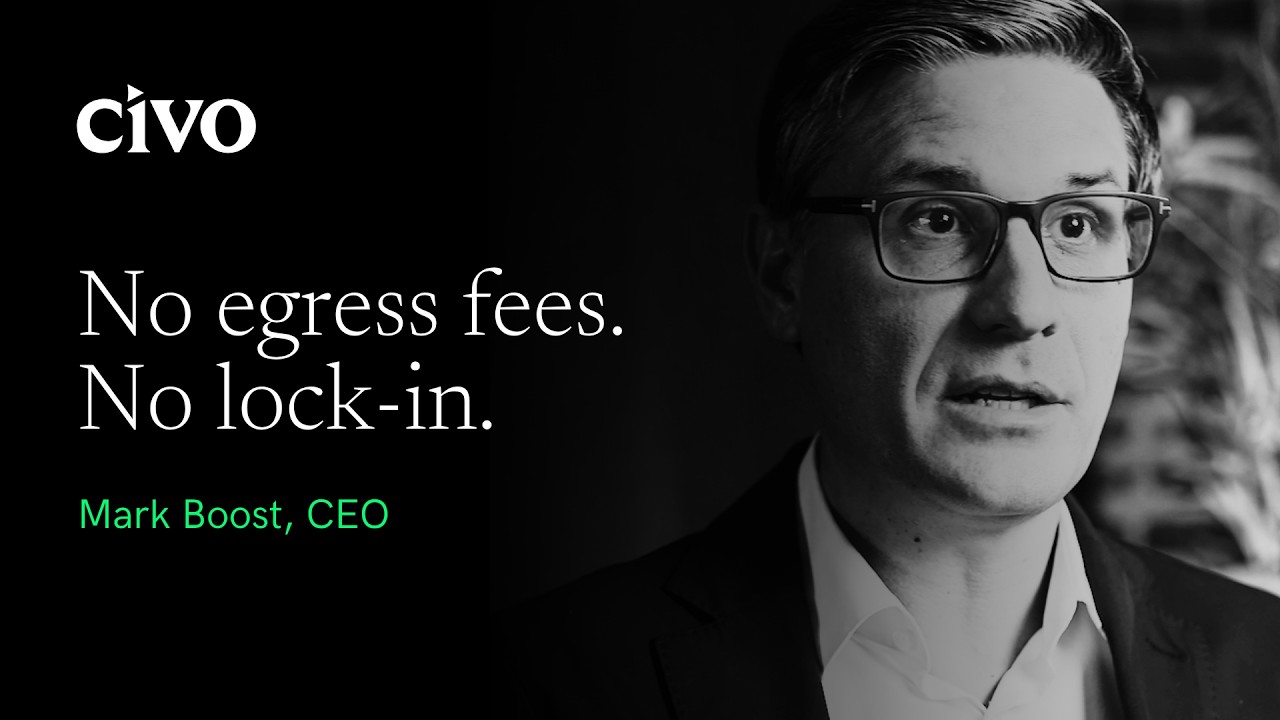
Civo charges no egress fees within the platform. Data can move as operational requirements demand, without a financial disincentive attached to retrieval or migration. For regulated organizations that need to maintain genuine control over their data - including the ability to extract it, audit it, and move it - that matters beyond the cost savings.
What Civo provides:
- Zero egress fees within the platform
- Removes the financial barrier to data retrieval, migration, and audit
- Supports data portability requirements under Article 20 of the UK GDPR and sector-specific frameworks
- Eliminates cost-driven lock-in as a data governance risk factor
6. How does Civo support compliance for financial services?
The UK financial services sector operates under some of the more prescriptive cloud adoption requirements in any industry. The FCA's operational resilience rules, the PRA's outsourcing and third-party risk management expectations, and DORA - now directly applicable to UK firms providing ICT services to EU-regulated financial entities or operating EU-supervised branches, with reach through supply chain obligations.
Key among those requirements: the ability to audit the infrastructure provider, enforceable exit provisions, and documented arrangements for business continuity that the firm, not just the provider, controls. Civo's sovereign cloud architecture supports all three. Data residency is contractual; exit provisions are enforceable under UK law rather than the jurisdiction of a US or EU parent company; and the Kubernetes-native architecture means the documented security posture corresponds to what's actually deployed.
What Civo provides:
- Supports FCA operational resilience and PRA outsourcing rule requirements
- Contractual data residency enforceable under UK jurisdiction
- Exit provisions governed by UK law - no foreign parent jurisdiction complications
- Architecture supports documented business continuity arrangements
7. What does carbon-neutral infrastructure mean for public sector procurement?
The UK government's Greening Government Commitments and the NHS's net zero commitments have made carbon footprint a substantive procurement criterion rather than a CSR footnote. Public sector organizations are increasingly required to demonstrate that their technology supply chain meets sustainability targets, and technology infrastructure - historically overlooked in carbon accounting - is coming under closer scrutiny.
Civo operates carbon-neutral infrastructure across its UK and EU deployments, backed by verified offsetting and ongoing commitments to reduce the carbon intensity of its operations. For public sector procurement teams that need to account for Scope 3 emissions, and for private sector firms with supply chain sustainability obligations, that's a meaningful data point - not just in winning contracts, but in maintaining compliance with frameworks that are tightening year on year.
What Civo provides:
- Carbon-neutral operations across UK and EU infrastructure
- Supports Scope 3 emissions accounting for supply chain sustainability reporting
- Relevant to NHS net zero commitments and Greening Government Commitments
- Sustainability credentials increasingly required in public sector procurement frameworks
What should regulated organizations look for in a UK sovereign cloud?
The market has no shortage of providers claiming sovereign cloud capability. Distinguishing genuine sovereignty from marketing positioning requires asking specific questions rather than accepting general assurances.
- Contractual residency, not architectural default: Ask whether data residency is guaranteed in the contract. If the answer involves phrases like "by default" or "unless required for operational reasons," that's not a guarantee.
- Jurisdiction of contract: Who governs the agreement - and whose courts have authority if there's a dispute? A UK-registered subsidiary of a US or EU parent company may not provide the jurisdictional clarity regulated organizations need.
- Independent certification: ISO 27001 certification should be current and independently audited. Ask for the certificate scope and the name of the certifying body.
- Exit provisions: Regulated firms need enforceable exit rights and data retrieval guarantees. Check whether exit provisions are in the standard contract or require separate negotiation.
- Audit rights: FCA and PRA rules require that regulated firms can audit their cloud providers or commission audits on their behalf. Confirm this is supported and what the practical mechanism is.
- Egress and portability: Zero or low egress fees support genuine data portability. High egress fees are a structural constraint on your ability to exercise the data rights you need.
FAQs
Marketing Team at Civo
Civo is the Sovereign Cloud and AI platform designed to help developers and enterprises build without limits. We bridge the gap between the openness of the public cloud and the rigorous security of private environments, delivering full cloud parity across every deployment. As a team, we are dedicated to providing scalable compute, lightning-fast Kubernetes, and managed services that are ready in minutes. Through CivoStack Enterprise and our FlexCore appliance, we empower organizations to maintain total data sovereignty on their own hardware.
Our mission is to make the cloud faster, simpler, and fairer. By providing enterprise-grade NVIDIA GPUs and streamlined model management, we ensure that high-performance AI and machine learning are accessible to everyone. Built for transparency and performance, the Civo Team is here to give you total control over your infrastructure, your data, and your spend.
Share this article