
The hidden costs of "free" cloud credits: A wake-up call for businesses
Written by

Chief Executive Officer (CEO) at Civo
Written by
Chief Executive Officer (CEO) at Civo
The Competition and Markets Authority (CMA) is investigating the state of the UK cloud market, and for good reason. While much of the discussion has focused on egress fees, technical lock-in, software licensing, and committed spend discounts, these are symptoms, not the root cause.
The single biggest threat to a healthy, competitive cloud landscape is the excessive use of free cloud credits.
This tactic, widely used by hyperscalers (AWS, Microsoft Azure, and Google Cloud), distorts competition at its core. It creates a market where adoption is driven not by merit, cost-efficiency, or innovation, but by who can afford to give the most away upfront.
How hyperscalers are getting new customers hooked
Among all these issues, the one that deserves the most urgent attention is the excessive use of free credits. My previous submission to the CMA documented instances of excessive free credits often reaching hundreds of thousands of pounds. With the rise of AI and ML, these figures are only ballooning in an attempt to further monopolise the AI and ML market.
This tactic is fundamentally unfair. Smaller providers simply cannot compete with such giveaways. It's a classic bait-and-switch – customers get enticed by the initial free tier, but switching later becomes a monumental task due to sunk costs and technical lock-in. This creates a monopoly for the big three hyperscalers, stifling innovation and preventing a truly competitive market from emerging.
The cloud credit trap: A three-phase strategy
“Free” cloud credits sound like a gift. In reality, they are a calculated mechanism to attract, entrench, and retain customers. Our research, outlined in the Decoding Cloud Credits whitepaper, shows this is not accidental. It’s a deliberately engineered three-phase strategy:
The business impact of free credits
The research highlights several key concerns associated with free cloud credits, including:
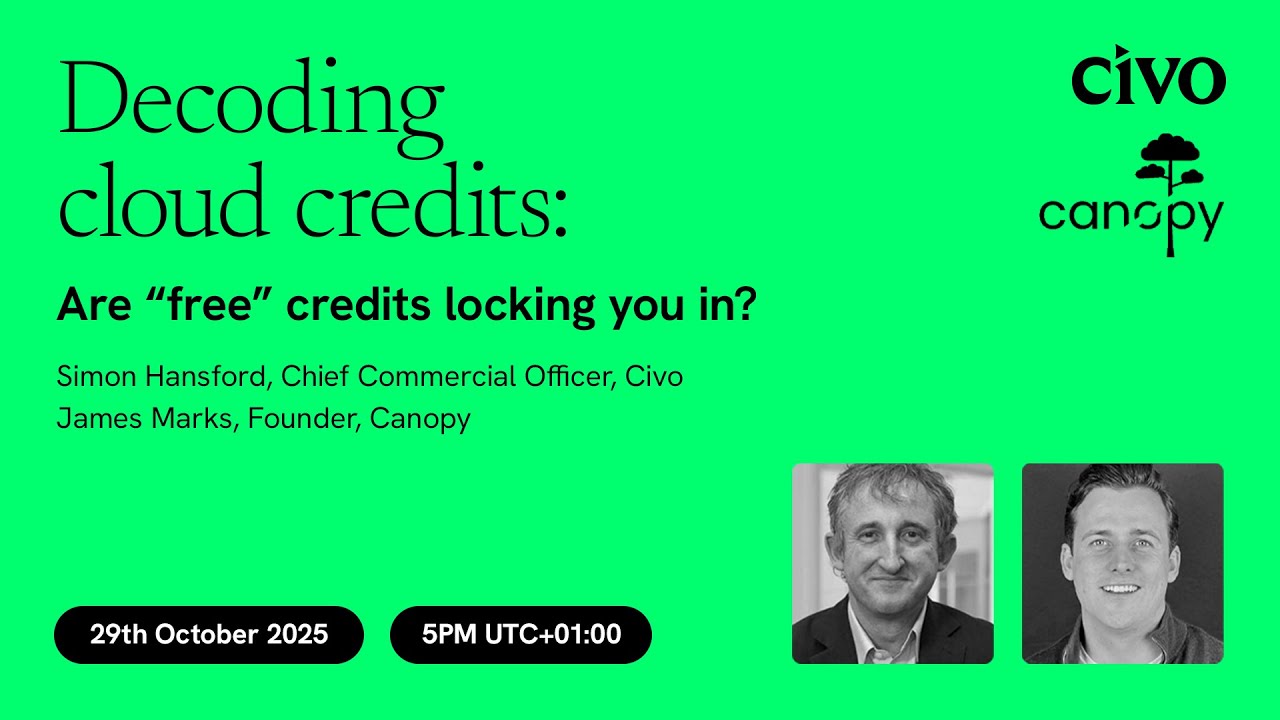
In our recent webinar, Simon Hansford (Chief Commercial Officer at Civo) and James Marks (Founder of Canopy) explored this critical topic, sharing their extensive experience in the cloud market to expose the hidden risks, hyperscaler strategies, and actionable steps businesses can take to regain control.
Want to catch up with the full session before we dive into the insights? Catch up below 👇
The word "free" creates a cognitive bias that makes teams less constrained when making architectural decisions, often leading to long-term liabilities.
James Marks defined cloud credits as a "virtual currency" used to entice customers. Simon elaborated on the core drivers for users (testing, performance confirmation, subsidization) but emphasized that the scale of credits offered by hyperscalers is calculated to get businesses "hooked," using a stark analogy:
"It’s a bit like... drug dealers hanging out on the street corner giving free drugs. They give free samples for a couple of months because they know at the end of it you’re hooked."
Other causes for concern
Away from the excessive free credits, the CMA investigation is focussed around other areas, which are also of concern. Let's dissect these areas to understand their impact:
The "escape plan": Building for portability and control
The most effective way to avoid the credit trap is to establish robust governance and choose platforms built on open standards. James Marks provided a detailed roadmap of the steps organizations must take, emphasizing that strategic planning is a competitive advantage.
James Marks emphasized the strategic importance of thinking long-term:
"I think it just comes back to thinking long term about some of the decisions you're making now and getting it right first time... and it'll pay dividends. You might have a bit of a short-term pain, but the gain is there in the long term."
James's essential strategies for building for portability and financial control include:
The alternative: Transparent pricing and open cloud
The webinar highlighted that alternatives focused on transparent, utility-based pricing and open-source standards can deliver up to 59% lower TCO over the long term. Civo's pricing model achieves this. As detailed in the whitepaper and referenced by the speakers, Civo delivers up to 59% lower costs than hyperscalers while maintaining enterprise-grade performance, even for GPU-intensive workloads. This isn't marginal optimization; it's financial liberation.
- Cost clarity: No hidden fees, just clear, predictable pricing.
- Optionality: Building on open standards gives you a commercial advantage when contracts are up for renewal, as you can easily negotiate or migrate.
- Sustainable growth: Civo's startup program offers a scalable approach to cloud credits that supports customers as they genuinely grow, rather than trapping them.
- Sovereignty: Using platforms like Civo can align with data sovereignty (UK-based) and regulatory needs.
Summary
If the UK wants a truly open and competitive cloud market, which puts the best interests of UK companies at its heart, urgent action is required. The emergence of AI and ML is only supercharging the stakes, with cloud players racing to build a platform fit for the AI revolution. Personally, I am not a fan of overregulation of any industry, but I do believe it’s important to have a level playing field. Many of the tactics deployed by the Big 3 hyperscaler providers are anti-competitive. Until changes are made, smaller providers will be locked out, and hyperscaler dominance will only grow.
What is Civo doing to help?
The implications of these findings are significant. As the cloud computing market continues to grow, businesses must be aware of the risks associated with "free" cloud credits and take steps to mitigate them. The UK government's recent investigation into the cloud computing market highlights the need for greater transparency and competition in the industry.
At Civo, we're committed to providing a cloud solution that prioritizes transparency, control, and flexibility. Our cloud infrastructure is designed to give businesses the freedom to choose where their data is stored, processed, and governed, and to provide them with the tools and support they need to manage their cloud environments effectively.
By offering simple, transparent billing with no hidden fees, we help businesses avoid the pitfalls of "free" cloud credits and ensure that their cloud spend is optimized for their needs.
Ready to unlock the full truth about cloud credits and protect your business?

Chief Executive Officer (CEO) at Civo
Mark Boost is the Chief Executive Officer and co-founder of Civo, a cloud computing provider focused on delivering fast, developer-friendly infrastructure. He founded the company in 2018 with the goal of building a modern Kubernetes-powered cloud platform.
Before launching Civo, Mark founded several successful technology companies, including LCN.com, ServerChoice, Ai Networks, and Bulletproof Cyber. With more than two decades of experience building infrastructure and hosting businesses, he has a long track record of scaling technology companies.
Share this article
